8lsanten ak8oi (Make Peace),
Cheryll
The Armchair Genealogist has issued the challenge – and I have answered it, I think. This challenge encourages genealogists and family historians to stop procrastinating and start writing.
My subject will be my great-great grandfather, William James Scott. He has been pretty elusive. While I knew his daughter, my great-grandmother, Nellie Louisa Scott Toney, I don’t recall her ever talking about her father. Grama Nellie died during my freshman year in college and I wish almost daily that I had asked her about her family.
I change my mind. I will write about Grama Nellie. Of course, William will be included as well. But I think if I am to take this challenge seriously, then I should write about someone I truly loved and respected. A woman who gave love to her family and always stood strong for them.
Here are a few facts from her life:
Please follow along while I write about this beloved woman. Or don’t. I will write on anyway.
8lsanten ak8oi (Make Peace),
CheryllUntil 1869, Massachusetts Indians were wards of the state, not subject to taxation and disenfranchised. The Enfranchisement Act of 1869 changed that – not only did the law make citizens of the Commonwealth’s Native population, it also opened up communal lands held by Natives for sale to non-Indians. Committees were formed to investigate Indian lands that might be subject to sale. One such investigation on the island of Martha’s Vineyard included a detailed census of the island’s Wampanoag residents.
In 1866, the legislature appointed a Commission to “complete the examination and determination of all questions of title to land, and of all boundary lines between the individual owners, at Gay Head, on the Island of Martha's Vineyard.” The “questions of title to land, and of all boundary lines” was a sore point with the Massachusetts government due to the Aquinnah’s unique method of distributing land to their tribal members.
When an Aquinnah came of age, he would fence off land from the common area for his own use. The size of the area did not matter – it could be 1 acre or 5 acres or ten. The amount depended on what the member felt he needed. Several legislative reports from the colonial period on remarked on the method of dispersal and claimed that it could not continue.indefinitely.
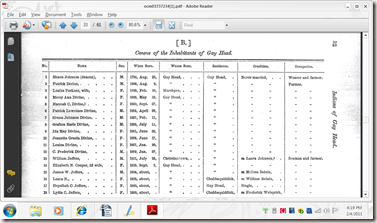
This 1866 report (published in 1870) not only defined boundaries between privately held Gayhead lands and common areas but included a census of all members of the tribe whether on the island or living elsewhere. The details included in the census is a genealogical goldmine of information. The screenshots below demonstrate the two page chart system.
Page 1 gives the assigned number of the member, name, sex, when born, where born, residence, condition (married, widowed, etc.), and occupation.
Page 2 lists the assigned number, when married, parents, parents’ residence, father’s birthplace, mother’s birthplace, father’s occupation.
This entire report can be found online at the State Library of Massachusetts at http://archives.lib.state.ma.us/handle/2452/48290
8lsanten ak8oi (Make Peace),
Cheryll